
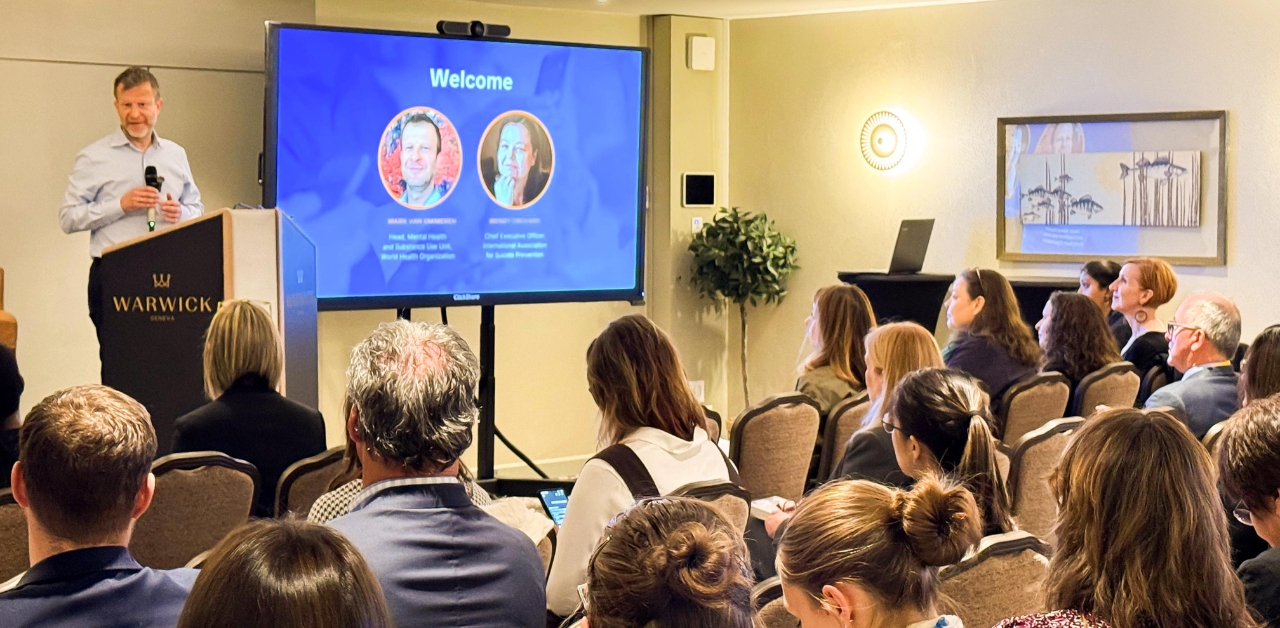
Digital technologies and artificial intelligence are rapidly changing how people, and young people in particular, seek information, form relationships and reach for support. At the 79th World Health Assembly in Geneva, IASP had the pleasure of coordinating a side event that brought these changes together with the question of safety. Online Safety: Artificial Intelligence, Social Media and Suicide Prevention was co-hosted by IASP, Orygen, Safe Online and Crisis Text Line.
More than 720,000 people die by suicide each year, with the true figure likely to be considerably higher. The event opened with Mark Van Ommeren, Head of the Mental Health and Substance Use unit at WHO, setting out WHO’s LIVE LIFE approach and drawing a connection between its four recommended interventions and the digital environment. Reducing access to means, responsible media reporting, building socio-emotional skills in young people, and early intervention all now have a digital dimension. Social media is itself a form of media, and the question of whether it reports responsibly on suicide, or increases the risk of imitative behaviour, is a pressing one.
The first panel, moderated by Marija Manojlovic, Executive Director of Safe Online, considered both the opportunities and the harms. The discussion moved beyond individual tools to the wider digital ecosystems that now shape how people understand the world. Panellists emphasised the importance of precision. There is an important distinction between a validated clinical tool and a general-purpose chatbot that a young person may turn to in distress, and policy responses need to reflect it.
Professor Jo Robinson, IASP President and Head of Research at Orygen, drew on a decade of research into social media and suicide prevention. Around 90 per cent of young people have used social media or AI tools, including in relation to their mental health. These platforms can foster connection and offer an avenue for support that is otherwise difficult to reach, particularly for young people in marginalised communities. They also carry significant risks, with research showing that many young people have been exposed to self-harm and suicide-related content online, much of it unsought. Margaret Meagher of Crisis Text Line described a referral pathway that is already taking shape, with social media platforms and AI tools signposting people in distress towards human support. The concern is that these referrals often occur without coordination, clinical standards or resourcing for the services that receive them. Saisha M of the Mariwala Health Initiative set out the realities of the majority world, where referral pathways have limited value in the absence of functioning, adequately resourced health systems to refer into.
The second panel, moderated by Nataya Branjerdporn of Orygen, centred the perspectives of four young people. Their contributions reflected both the harms and the value of the online environment. One panellist described being able to access detailed harmful content while already a patient in hospital, and the lasting effect of that exposure. Others spoke of social media as an essential means of connection in remote communities, and of the difficulty of placing responsibility for online safety on parents and carers alone. A consistent theme was that young people do not wish to be excluded from digital spaces, but to be involved as partners in their design and governance, supported by genuine co-creation.
The concerns explored at the side event were reflected throughout the wider Assembly. In the debate on non-communicable diseases and mental health, a number of member states raised closely related issues. Belgium welcomed the recognition of the impact of digital services on mental health within the political declaration. Germany’s youth delegate identified the uncertainties of AI and endless online scrolling as defining features of a generation’s experience. Brazil pointed to online harms including cyberbullying and addictive gaming, and Namibia linked the rising burden of mental health conditions among young people to rapid technological change. Several countries described integrating AI into detection and care, a reminder that adoption is advancing ahead of the evidence and the safeguards.
Within the dedicated discussion on data, digital health and artificial intelligence, member states agreed that countries need reliable health data and interoperable systems before advanced tools such as AI can help safely, that shared global standards should leave room for each country’s own context, and that new technology must reduce gaps in care rather than widen them. Civil society voices, including IASP, raised concerns about online harm, the influence of the technology industry, and the exposure of young and vulnerable people to harmful content through algorithmic systems.
Closing the Assembly’s discussion, WHO acknowledged member states’ concern about the risks that digital technology poses to the mental and physical health of children and young people, and confirmed that it is monitoring the evolving evidence and working to promote online safety through technology design, digital health literacy and stronger oversight of digital platforms. The 2025 political declaration on NCDs and mental health provides a mandate for this work. As many delegations noted, the priority now is implementation.
Several shared priorities emerged throughout all these discussions. There is a need for a clear and adequately resourced handoff to a trained person, rather than a disclaimer or a list of hotlines. There is a need for regulation that addresses systems and design, and not only individual content or prompts. There is a need for investment in the human services towards which AI so often directs people. And there is a need for young people to be involved as partners, not only as consultees.
The co-hosting organisations of the side event have committed to a summary paper, which will be shared widely, and a recording of the event is available on the IASP website. IASP will continue to take this work forward, including through its developing work on suicide prevention and artificial intelligence. As Crisis Text Line’s Margaret Meagher reflected in closing, there is a great deal of work ahead, but partners are stronger together. The evidence on one point is already clear. Human-to-human connection saves lives, and the task now is to build digital systems that protect it.
WATCH THE RECORDING:
IASP would like to extend our thanks to our co-hosting partners Orygen, Safe Online and Crisis Text Line, and to all the panelists.