

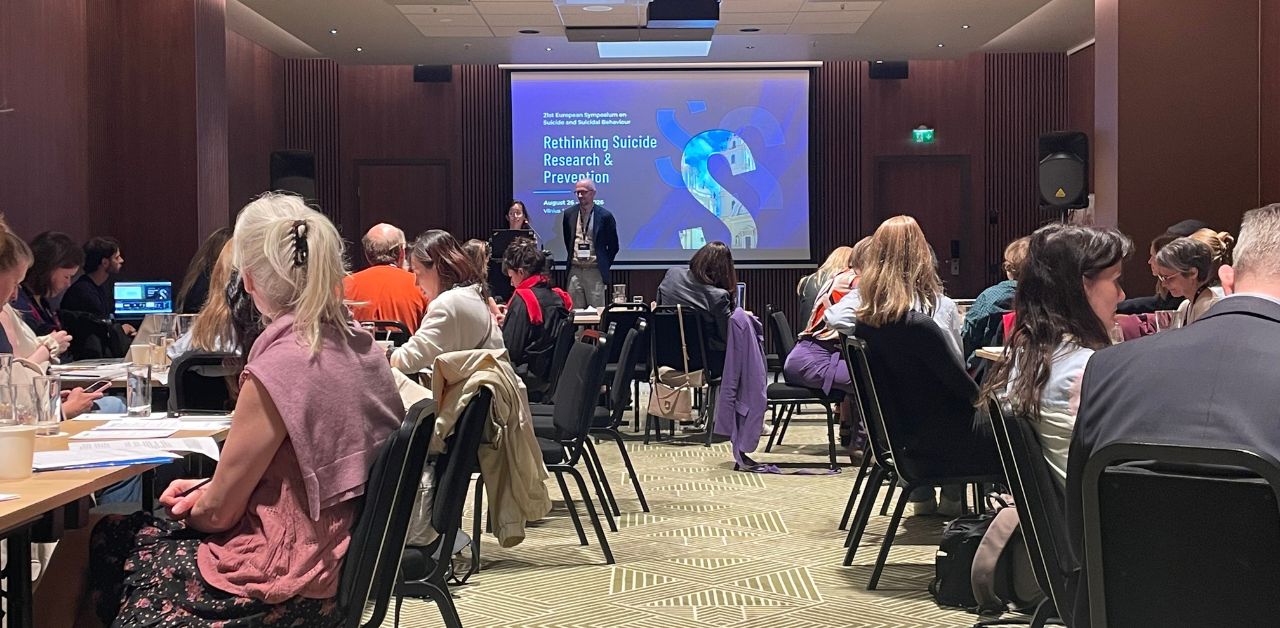
The Europe region of the Partnerships for Life Global Initiative to Prevent Suicide has recently taken on more content-oriented activities that support specific aspects of prevention strategies. As part of this work, a pre-conference workshop titled Rethinking Needs and Responses After Suicide, Assisted Suicide and Euthanasia, or Suicide Attempt was held during the 21st European Symposium on Suicide and Suicidal Behaviour in Lithuania in August.
The workshop opened with three short presentations, each exploring a different aspect of postvention and aftercare. Dr Eve Griffin (Ireland) presented models of postvention, drawing on AfterWords, a national survey of people bereaved by suicide, to examine how its findings inform the priority recommendations and actions outlined in Ireland’s new national suicide and self-harm reduction strategy. Dr Zrinka Laido (Estonia) then addressed models of attempt aftercare, drawing on European approaches to active follow-up and highlighting the importance of early contact and continuity of care with a consistent practitioner. Finally, Professor Dolores Angela Castelli Dransart (Switzerland) explored assisted dying and the challenges of aftercare, focusing in particular on the difficulties faced by families, including bureaucratic complexity, uncertainty, intense emotions and the risk of stigmatisation.
The second part of the workshop was inspired by the World Café method. Participants joined small groups to discuss vignettes which gave working groups particular cases to consider, identify their priority needs, reflect on strengths and barriers in addressing those needs, and propose recommended actions that could inform suicide prevention strategies.
The workshop was well-received by those who attended, particularly the format of short, topical presentations followed by facilitated small-group discussions. It enabled attendees to exchange experiences and perspectives across different countries and professional contexts. Respondents also singled out the quality of the speakers and facilitators, the variety of vignettes used to prompt discussion, and the sense of collective reflection the table format created.
In identifying broad topics for the Partnerships for Life network in Europe to consider, postvention remained a recurring theme, and participants suggested revisiting it at future events. Particular focus was encouraged on postvention for mental health professionals, the role of trained peers, and digital bereavement support. Participants also valued the workshop’s broad scope, which addressed the relationship between suicide attempts, death due to suicide, assisted dying and euthanasia. This is conceptually challenging, but they described it as important to confront openly, alongside cultural differences and persisting stigma in the field. These are all important considerations when implementing national suicide prevention strategies.
The discussion will continue in a webinar on Thursday, 22 October 2026, at 9:00 AM UK time / 10:00 AM CET. The webinar will bring together the same three speakers and will be chaired by the Regional Coordinators, Professor Vita Poštuvan and Professor Thomas Niederkrotenthaler.