
Hi friends.
First, let me start with a huge thank you to everyone who marked World Suicide Prevention Day on 10 September. Whether you lit a candle, joined Move for Life, hosted an event or started a conversation in your community, you helped carry the message that suicide is preventable to every corner of the world.
Over World Suicide Prevention Day, we also published our Global Review 2026, a global review of national suicide prevention strategies. It brings together 109 national documents across 63 countries, organised by WHO region, and shows that while progress has been made, these commitments are still far from universal. The review is updated each year, and we welcome corrections and additions at globalinitiative@iasp.info.
Coming up on the 10th October we mark World Mental Health Day. This year’s theme, set by the World Federation for Mental Health, is “Lived experiences heard: real voices, real change”. This theme reflects the principle that the people closest to suicide should help shape how we prevent it and I am pleased to share below some of the ways we are putting that into practice.
This year’s World Mental Health Day theme is the right moment to share how we are embedding lived experience across IASP’s leadership and work. At IASP, a lived experience of suicide means having experienced suicidal thoughts, survived a suicide attempt, supported a loved one through a suicidal crisis, or been bereaved by suicide. As part of our Organisational Strategy 2024–2028, we are committed to including lived experience in IASP’s governance and programmes, and we are introducing two dedicated lived experience positions on our Board, so that this perspective informs our decisions at a strategic level. A Lived Experience Advisory Group will be established under the guidance of our Special Interest Groups on Lived Experience and on Bereavement and Postvention. The Advisory Group will develop the terms of reference and selection process for the Lived Experience Representatives to the Board, and will be a resource for IASP’s groups and programmes.
This World Mental Health Day we are also highlighting our updated Policy Position on the Decriminalisation of Attempted Suicide, which sets out the evidence that criminalising suicide attempts does not prevent suicide. Instead, it stops people from seeking help, drives underreporting, deepens stigma and limits what governments can do to prevent suicide. Since we adopted our position in 2020, six countries have decriminalised attempted suicide. That progress matters, but it is not guaranteed, and reform has to be protected. Legal change also works best when it comes with investment in services, training and data. It is a principle shared by United for Global Mental Health’s Care Not Custody campaign, which calls for rights-based care in the community in place of coercive responses to mental distress. I encourage all of you to read the paper and share it with policymakers and partners in your country.
In other news, last month we held our first Asia Pacific Regional Forum in Fiji. It was a wonderful few days, and I want to say a personal thank you to our hosts, co-chairs, speakers, partners, Central Office team and everyone who joined us on Denarau Island. The idea exchanges were a real highlight, giving delegates space to share what is working in their own countries and to test ideas with colleagues facing similar challenges. The Partnerships for Life sessions brought together people leading national and community suicide prevention efforts across the region. We received such a warm welcome, and I am sure that the connections made there will carry on well beyond the forum.
Next, we look ahead to our Pan America Regional Forum in San José, Costa Rica, from 9 to 11 November. Delivered bilingually, the forum holds regional realities at the centre of the programme. Sessions will explore suicide prevention in a digital world, including how young people are becoming partners in prevention rather than audiences for it, and how platforms, researchers and creators can work together to build safer online spaces. The programme also takes a careful look at artificial intelligence, its opportunities, risks and responsible practice, and at how the way we talk about suicide, in the media and in everyday language, can itself help prevent it. Presentations on crisis lines, 988 and integrated crisis systems across the Americas will look at how services reach people at the moment they need support, alongside national strategies and the region’s Partnerships for Life work. Running through it all is community, and the connections to family, peers, culture and place that are among the strongest protective factors across the region. The Americas are home to extraordinary expertise in suicide prevention, and I hope many of you will join us. Registration is open now.
Looking further ahead, preparations continue for our 34th World Congress in Colombo in 2027, and I hope to see many of you there.
This World Mental Health Day, I hope you will join us in making space for people with lived experience to be heard, and in making sure what we hear leads to change. Thank you, as always, for everything you do.
Warm regards,
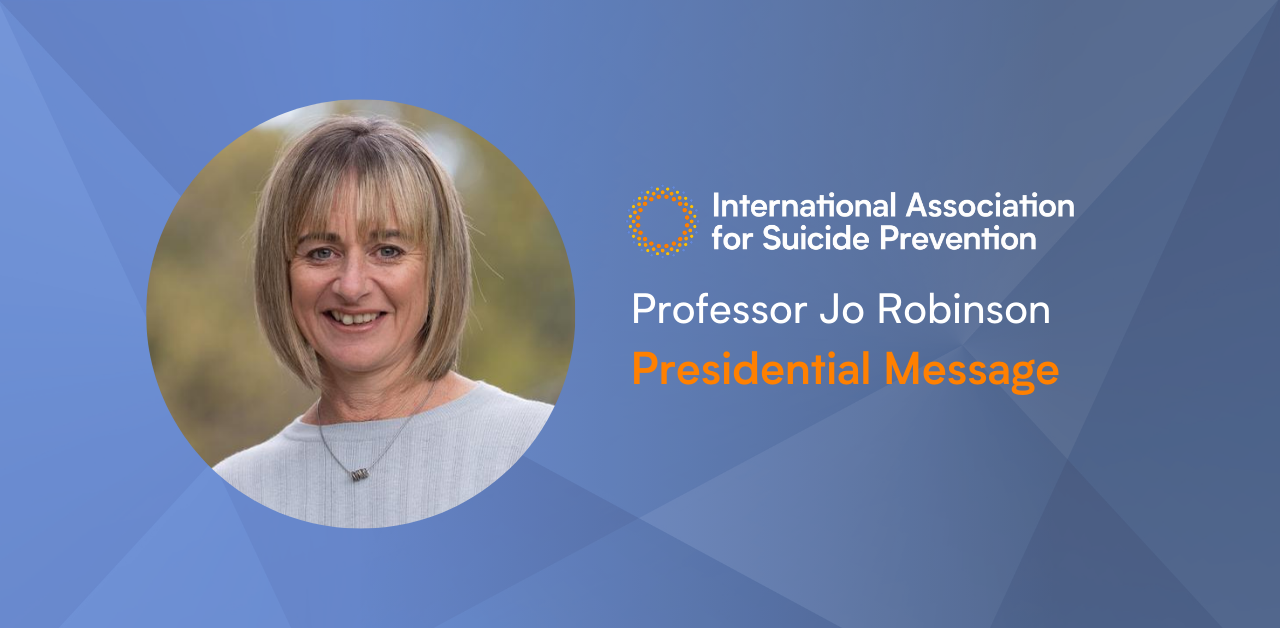
Professor Jo Robinson
President, IASP
Update on Board Activities from the General Secretary
Low- and middle-income countries (LMICs) bear the highest burden of suicide. To address this, the Board is rolling out an IASP engagement and consultation initiative with LMIC networks—both within and beyond our membership—to better understand how IASP can prioritize effective global partnerships in suicide prevention. In addition to the development of an organisational ethics position, the Governance and Ethics Subcommittee is also developing a document on organisational governance principles, which align with IASP’s Vision, Mission and Values.
The Board is reviewing and realigning its conference business model to ensure that the World Congress and regional forums serve distinct and complementary purpose. Both will emphasise translating evidence into real-world implementation and on meaningful lived-experience contribution and participation. While the World Congress will continue to provide a platform for global research exchange, regional forums will increasingly emphasise accessible, practical and interactive formats that are responsive to local and regional needs, cultures and priorities.